Hepatitis E virus (HEV) infections in Europe are under-reported since most people do not present with symptoms. However, in individuals with compromised immune systems, HEV can cause a severe form of inflammation in the liver. According to the European Centre for Disease Prevention and Control, European HEV cases have been steadily increasing in the period 2005-2015. At Octapharma plasma donations are screened for HEV using a validated and approved quantitative PCR assay and positive units are excluded from downstream pharmaceutical production.
To gain further insight into the rates of HEV infection in Europe, a study led by Dr. Rasmus Gustafsson reviewed screenings for HEV RNA in a very large group of blood donors in Germany and Portugal (a total of 191,236 donations) (Figure). They used a standardized method which detects active infection of HEV and allowed direct comparisons between the two countries and identified how infection pattens vary seasonally. They saw a significantly higher incidence of HEV infection in the German cohort (p<0.0001) and amongst males (p=0.0002). An increase of HEV infection with age which peaked amongst the 41-50 years age group, before levelling-off at 60 years old, was also observed.
Consumption of under-cooked pork products has been shown to be the primary risk-factor for acquiring HEV in Germany. Therefore, the team assumed that HEV incidence rates might differ in summer, when cooking habits and behaviours may change. Indeed, they found that HEV infections were most prevalent in May-July, confirming a seasonal distribution. Also, men eat up to twice as much meat and processed meat products than women, which would increase their HEV exposure risk and may explain the gender distribution in HEV prevalence that the authors saw in their current study. They also investigated ABO and Rh(D) blood group phenotypes but found that they are not associated with HEV infection incidence. This study is beneficial for increasing awareness of the current state of HEV epidemiology in Europe.
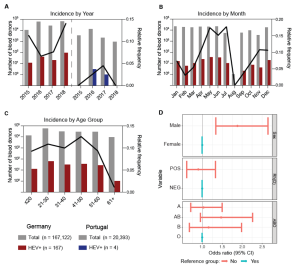
Figure. Key findings of the study.
Read the full research article (J Viral Hepat. 2022 May 2) https://doi.org/10.1111/jvh.13682