Hepatitis E virus (Paslahepevirus balayani, HEV) is a major cause of acute hepatitis worldwide, yet its impact in Latin America remains underexplored. Evidence suggests that chronic liver disease (CLD) patients infected with HEV face increased risks of disease progression and mortality, including acute-on-chronic liver failure (ACLF) or progression to chronic hepatitis E. Most studies on HEV epidemiology originate from Europe, the Middle East, and North Africa. In Latin America, HEV circulation has been reported, mainly in Brazil and Argentina, with seroprevalence estimates ranging from 0% to 66.3%, depending on population group, country, and assay utilized. However, HEV remains underexplored in this region, where it is rarely included in national diagnostic algorithms and testing capacity is limited.
During this multinational study, the team assessed HEV infection in CLD patients from Latin America and potential associated factors, including the PROGINS haplotype, a mutation in the progesterone receptor gene which has been proposed to influence susceptibility to HEV.
They analyzed 971 patients from Latin America. Among these, 784 samples were from individuals with CLD, recruited from six South American countries as part of the ESCALON consortium (www.escalon.eu) between 2019 and 2023 in major hospitals: Argentina (n = 224 from Cordoba and Buenos Aires), Brazil (n = 69 from Porto Alegre), Chile (n = 115 from Santiago), Colombia (n = 259 from Bogotá), Ecuador (n = 61 from Quito), and Peru (n = 56 from Lima). Additionally, 187 samples from healthy controls (HC) were collected in Argentina, Brazil, Chile, and Colombia. Anti-HEV IgG and IgM antibodies were tested by ELISA (Diapro, Italy). All samples were tested for anti-HEV IgG, and IgM was assessed in positive or equivocal samples. A subset of samples (n = 561), stored under conditions suitable for molecular biology analyses were tested for HEV RNA by real time RT-PCR. Positive samples were amplified by RT nested-PCR amplification, sequenced by Sanger and subjected to phylogenetic analyses. Among anti-HEV IgG-positive CLD patients, 98 samples were analyzed for PROGINS haplotype by PCR, and IgG-negative CLD patients (n = 119) were also included. Statistical analyses were carried out with R.
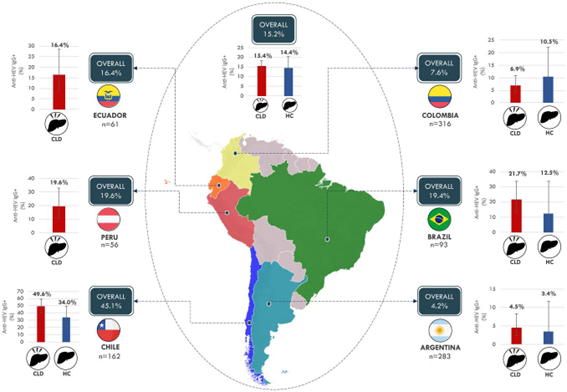
The overall anti-HEV IgG seroprevalence was 15.2%: 15.4% in CLD and 14.4% in HC, with no statistical difference. Marked geographical disparities were observed, with Chile showing the highest (45.1%) and Argentina the lowest (4.2%) anti- HEV IgG detection rates. Individuals with cirrhosis showed higher IgG rates (18.7%; 117/ 627) than those without (3.8%; 6/157). Odds of being IgG + were 3.07 times higher in patients with cirrhosis compared with patients with CLD without cirrhosis (P = .01). Also, anti-HEV IgG detection rates were higher in alcohol-related cirrhosis patients (20.9%, OR 5.03) than in individuals with non-cirrhotic CLD of other etiologies (3.9%, P = .001). Neither age nor sex influenced HEV seroprevalences. PROGINS haplotype showed no significant association with HEV infection. Anti-HEV IgM and HEV-RNA were detected in 11.2% (20/179, 95% CI 7.1–16.9) and 0.4% (2/561, 95% CI .0–1.4) of participants, respectively. Phylogenetic analysis confirmed zoonotic HEV-3 circulation in the region.
This first multinational assessment of HEV in Latin America reveals heterogeneous seroprevalence across countries. Particularly in Chile, HEV may be highly endemic, underscoring the need for increased screening efforts and awareness. Findings support considering HEV testing in diagnostic protocols for CLD patients, particularly those with cirrhosis or ALD- when presenting with unexplained hepatic decompensation or acute hepatitis. Additionally, preventive strategies should prioritize high-risk groups, such as promoting sanitation practices and the avoidance of undercooked meat (pork, wild boar and venison) and shellfish, as recommended by the EASL guidelines. Further research is needed to better identify high-risk groups within the CLD population and assess whether HEV screening in specific cohorts could improve disease management and patient outcomes.
Read the full article: J Infect Dis. 2026 Jan 28:jiaf615. DOI: 10.1093/infdis/jiaf615