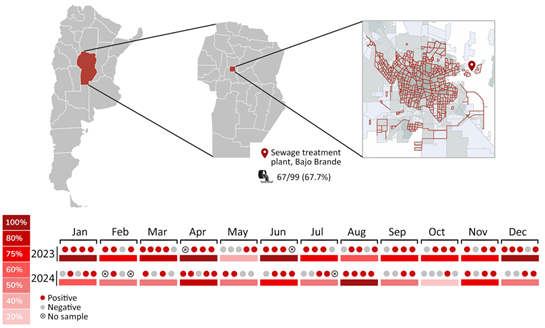
This study reports evidence of rat hepatitis E virus (R-HEV) circulation in central Argentina through wastewater surveillance, being the first report of this emerging virus in the country.
R-HEV belongs to the species Rocahepevirus ratti within the Hepeviridae family, which also includes Paslahepevirus balayani (hepatitis E virus), the causative agent of hepatitis E in humans. Rats are the main reservoirs of R-HEV, and although the virus has been detected in various countries—primarily in Europe—human cases have increasingly been reported since the first documented infection in a transplant patient in Hong Kong in 2018. Subsequent cases reported in Asia, Europe, and North America, affecting both immunocompromised and immunocompetent individuals, highlight the zoonotic potential of R-HEV and its growing public health relevance.
Because R-HEV is transmitted via the fecal-oral route, infected humans and animals shed the virus in their feces, which can then reach wastewater systems. Therefore, wastewater surveillance constitutes a valuable tool for virus surveillance. In South America, evidence of R-HEV circulation is extremely limited, with only one previous report describing low-prevalence detection in mangrove bivalves in Brazil. No prior reports had documented R-HEV in humans, animals, or sewage in Argentina.
To address this knowledge gap, researchers conducted weekly wastewater sampling from January 2023 to December 2024 at the Bajo Grande wastewater treatment plant in Córdoba city, in Central Argentina. A total of 99 sewage samples were collected and concentrated using polyethylene glycol precipitation. Viral RNA was extracted and analyzed by real-time RT-PCR targeting a fragment of the ORF1 R-HEV genomic region. Positive samples were further subjected to RT-heminested PCR amplification for sequencing and phylogenetic analysis.
Of the 99 samples analyzed, 67 (67.7%) tested positive for R-HEV RNA by real-time RT-PCR. Detection rates were higher in 2023 (77.6%) compared to 2024 (58.0%), but positive samples were identified throughout both years, indicating sustained viral circulation. Among the positive samples, 14 were successfully amplified by nested PCR, and 10 yielded sequences for phylogeny.
Phylogenetic analysis confirmed that all strains belonged to Rocahepevirus ratti and clustered within genotype C1. The sequences grouped closely with strains previously detected in sewage in Italy and in rodents from Canada. Most sequences were classified within the proposed clade I, subtype a, according to a recently developed genotyping platform. Although the sequences clustered together, they showed some genetic variability (similarity ranging from 0.71 to 0.98), suggesting ongoing circulation of closely related strains over the two-year study period. Conclusions remain limited due to the small number of available reference sequences globally and the relatively short genomic fragment analyzed.
In conclusion, this study provides the first evidence of R-HEV circulation in Argentina and confirms the presence of this emerging virus in South America. The high detection rate in wastewater suggests substantial viral circulation in the local environment. While contamination from human excretion cannot be ruled out, the most plausible source is infected rodents within the sewer system. These findings underscore the need for further investigation, which should integrate environmental surveillance with clinical testing of symptomatic patients and studies of potential animal reservoirs, particularly rats and possibly pigs. Overall, wastewater-based surveillance proves to be a powerful tool for detecting emerging zoonotic viruses and guiding public health measures.
Read the full article: Emerg Infect Dis. 2026 Jan;32(1):133-136. DOI: 10.3201/eid3201.251218