Hepatitis E is the most common cause of acute viral hepatitis worldwide, yet in high-income countries it remains oddly invisible. In Europe, most infections are caused by genotype 3 (gt3), a strain that circulates between pigs and people and is picked up mainly by eating undercooked pork. The great majority of these infections cause no symptoms, or only mild ones, so they never reach a doctor. The result is a striking mismatch: in Belgium, serological studies estimate roughly 54,000 infections every year, while only 25 to 117 cases are formally reported. It seems almost the entire iceberg sits below the waterline.
A new study led by Noor Ul Hudda with support from Marie De Smedt, with senior authors Prof. Thomas Vanwolleghem and Prof. Peter Delputte at the University of Antwerp, in collaboration with the Belgian Public Health Institute Sciensano, asks a simple question: if people shed Hepatitis E virus (HEV) in their stool, can we track the virus in the sewers, the way we learned to track SARS-CoV-2 during the pandemic? Published in Science of the Total Environment (2026), it is the first long-term, high-frequency wastewater analysis for HEV detection in Belgium.
What they found
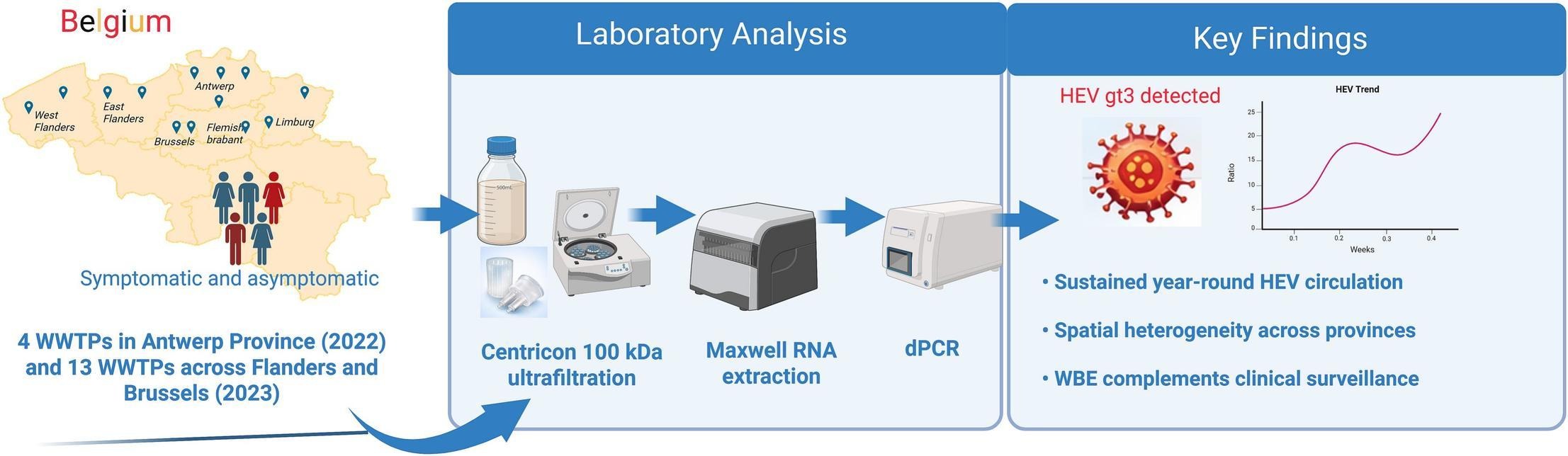
The team analysed untreated wastewater weekly across 2022 and 2023, using digital PCR for precise, absolute measurement and normalising each result to pepper mild mottle virus (a marker of how much human faecal material is in the sample). They started with four treatment plants in Antwerp Province in 2022, covering about half a million people, then expanded to 13 plants across Flanders and Brussels in 2023, serving roughly 2.6 million inhabitants, close to a quarter of the country.
The virus was almost everywhere. HEV RNA appeared in more than 90% of all samples, showing sustained, year-round community circulation. But the signal was not flat. It seemed to rise and fall with the seasons: an early-summer surge in 2022, and in 2023 a clear summer peak (July–August) followed by a second, broader rise in autumn (October–November). The picture also varied markedly from place to place, with strong signals in parts of Antwerp and a persistently low normalized signal in Brussels, even though the virus itself was still detected in nearly every sample there.
The most important finding was that the sewers revealed what the clinic did not. Across both years, the wastewater signal showed no correlation with the trickle of clinically reported cases. Traditional surveillance was capturing only a small, unrepresentative sliver of the infections in the population.
Why it matters for HEV epidemiology
This work turns an educated guess into measured evidence. It suggests that HEV infects widely and continuously in Belgian communities, possibly with a seasonal rhythm and a spatial variation that is invisible to passive clinical reporting. The observed warmer-month peaks fit the idea of food-driven transmission, which can be speculatively linked to barbecue-season and, in autumn, to game meat from the hunting season. Nevertheless, this though the study treats these as hypotheses rather than conclusions as clearly more research is needed.
For public health, the message is that wastewater-based epidemiology offers a sensitive, population-level complement to clinical surveillance. It cannot replace a diagnosis, but it can provide the missing scale and timing of circulation that is currently unknown. Strong surges detected in wastewater could also inform clinicians to be vigilant when counseling vulnerable patients such as pregnant women and immunocompromised individuals, and support authorities in taking additional measures when needed.
What comes next
The authors lay out a clear road ahead. Sequencing the virus from wastewater would allow specific strains and variants to be tracked and their sources attributed. Mathematical models combining wastewater, clinical, and seroprevalence data could finally translate a signal in the sewers into an estimate of true incidence. Better data on how long and how much people shed the virus would sharpen those estimates, while extending coverage to more wastewater stations across Belgium would complete the national picture. Investigating why some regions light up and others stay quiet, by linking wastewater to human activities and behaviour such as pig farming, hunting, and food distribution, could reveal the real drivers of exposure. It is worth noting that the assay used here does not detect rat hepatitis E, an emerging concern for human infections that future work will need to address separately.
Hepatitis E has long hidden in plain sight. This study shows that, quite literally, the evidence has been flowing beneath our feet all along, and that we now have the tools to read it.
Original publication: Hudda NU, De Smedt M, Janssens R, et al. What lies beneath? Hepatitis E virus surveillance in Belgian wastewater suggests hidden trends in community circulation. Science of the Total Environment. 2026;1048:182052.