Hepatitis E virus (HEV), a major cause of both acute and chronic viral hepatitis, is estimated to cause over 19 million symptomatic cases and 44 000–70 000 deaths. As a zoonotic virus, HEV poses a considerable risk of transmission and spread to human populations. Currently, no Food and Drug Administration (FDA)-approved drug against HEV is available.
G-quadruplex (G4) is a class of non-canonical secondary structure adopted by DNA and RNA molecules, which has garnered attention in areas such as therapeutic targets and disease diagnosis. It is characterised by four guanine stretches positioned in stacked planar quartets stabilised by Hoogsteen base pairs. Multiple sequences with a G4 secondary structure have been identified in the RNA genomes of various viruses, including yellow fever virus, SARS-CoV-2 and HIV. A recent study has demonstrated that the negative-strand RNA of HEV harbours a conserved sequence capable of adopting a G4 structure[1]. These viral G4 structures have been found to play essential roles in different stages of the viral life cycle, including replication and translation.18 19 Targeting G4 structures in the viral genome may thus represent a promising antiviral strategy. G4 ligands such as pyridostatin (PDS) and TMPyP4 exert their effects by binding to and stabilising the G4 structure and have demonstrated antiviral activity against multiple viruses in vitro; however, relevant and extensive in vivo studies remain limited. CX-5461 (also known as Pidnarulex) was originally characterised as an inhibitor of RNA polymerase I-driven rDNA transcription and has recently been
identified as a potent G4 stabiliser.20 It is a first-in-class anticancer drug with FDA Fast Track Designation. Phase I clinical trials in patients with BRCA1/2, PALB2 or other DNA repair-deficient breast and ovarian cancers have been completed or are ongoing. However, whether CX-5461 also has antiviral activity has not yet been reported.
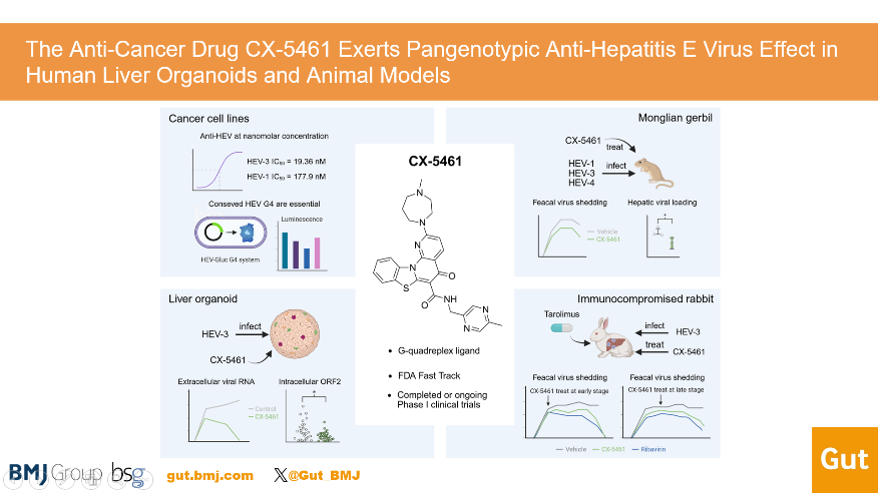
Recently, Dr. Lin Wang in Peking University, Beijing, China, demonstrates that CX-5461 exhibits antiviral effects in cancer cell lines and human liver organoids derived from induced pluripotent stem cells (iPSCs) at nanomolar concentrations. CX-5461 exhibits in vivo antiviral activity in a Mongolian gerbil infection model against HEV genotypes that are pathogenic in humans, including HEV-1, HEV-3 and HEV-4. CX-5461 also demonstrates antiviral efficacy at both the early and stable phases of viral replication during chronic HEV infection, representing a promising candidate for the clinical treatment of this condition. The study has been recently published in Gut[2].
References:
[1] Ding X, Zeng D, Bian Y, Liu D, Li Q, Si R, Sha Y, Fu H, Li Y, Ding X, Liu X, Li N, Liang S, Ding Y, Wang W, Guo H. Identification of G-Quadruplexes in Hepatitis E Virus Negative-Sense Genomic RNA as Potent Antiviral Targets. ACS Infect Dis. 2026 Feb 13;12(2):854-868. doi: 10.1021/acsinfecdis.5c01069. Epub 2026 Jan 28. PMID: 41603759.
[2] Li Y, Jiang B, Zheng L, Liu X, Fan Q, Yang X, Mao H, Li B, He S, Shi D, Gu X, Li X, Wei G, Zhan P, Li K, Liu T, Yin X, Wang L. Anticancer drug CX-5461 exerts pangenotypic anti-hepatitis E virus effect in human liver organoids and animal models. Gut. 2026 Nov 2:gutjnl-2026-339410. doi: 10.1136/gutjnl-2026-339410. Epub ahead of print. PMID: 42971755.