Hepatitis E virus (HEV) is traditionally regarded as a hepatotropic virus, but an increasing body of evidence has revealed its ability to infect tissues outside the liver. In recent years, detection of HEV RNA in semen from chronically infected patients has raised important questions regarding the role of the male reproductive tract in viral persistence and the possibility of sexual transmission. However, the mechanisms underlying these observations have remained largely unexplored.
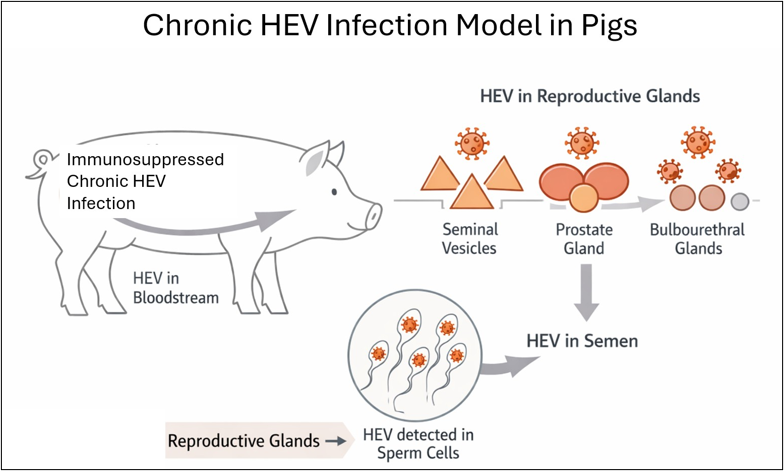
In a newly accepted study published in Virulence, Yadav, Kenney, and colleagues employed a porcine model of chronic HEV infection to investigate the interaction between HEV and the male reproductive system. Using immunosuppressed, ribavirin-treated pigs infected with HEV-3, the authors examined viral persistence in reproductive tissues, sperm quality, and the potential contribution of male accessory glands to chronic infection.
The investigators demonstrated that HEV was associated directly with mature sperm cells, predominantly localizing to the sperm head. Importantly, virus recovered from sperm remained infectious when inoculated onto human hepatoma cells, confirming that sperm-associated HEV was viable and replication competent. Viral RNA concentrations were higher in sperm cells than in seminal fluid, suggesting that sperm themselves may represent an important compartment for viral carriage.
Beyond sperm cells, the study identified multiple sites of viral replication within the male reproductive tract. HEV antigen and viral RNA were detected in the prostate gland, seminal vesicles, Cowper’s gland, epididymis, and testicular tissues. These findings are particularly noteworthy because the accessory glands contribute the majority of seminal fluid volume and may therefore represent previously unrecognized reservoirs of virus within infected individuals.
The consequences of infection extended beyond viral persistence. HEV-infected animals exhibited reduced progressive sperm motility, increased sperm abnormalities, disruption of the blood-testis barrier, leukocyte infiltration, and evidence of apoptosis within reproductive tissues. In addition, infected pigs displayed reduced serum testosterone concentrations during later stages of infection. Together, these findings suggest that HEV infection may adversely affect male reproductive health while simultaneously establishing niches that support persistence of the virus.
The work also complements recent clinical observations. Previous studies have reported HEV RNA and infectious HEV particles in semen from chronically infected men, including cases in which semen remained positive despite resolution of detectable viremia and fecal shedding. By demonstrating viral persistence within reproductive tissues of a natural host species, the present study provides a biologically plausible explanation for those clinical findings.
Although sexual transmission of HEV has not yet been conclusively documented in humans, these results strengthen the rationale for further investigation. The identification of the testis and accessory sex glands as potential viral reservoirs highlights the possibility that the male reproductive tract could contribute to prolonged infection, relapse after treatment, or alternative routes of virus dissemination.
As recognition of the extrahepatic manifestations of HEV continues to grow, this study expands our understanding of viral tropism and persistence. Future studies in both animal models and human patients will be needed to determine how long infectious HEV persists in reproductive tissues, whether sexual transmission contributes to human infection, and how these findings may influence clinical management of chronically infected individuals.
Dr. Kush Kumar Yadav is an Assistant professor at the Department of Animal Sciences, College of Food, Agricultural and Environmental Sciences, The Ohio State University.
Dr. Scott P. Kenney is an Associate Professor at Center for Food Animal Health, Department of Animal Sciences, College of Food, Agricultural and Environmental Sciences, The Ohio State University.
Read the full article published in Virulence. 2026, DOI: 10.1080/21505594.2026.2707701