By Nabila Jabrane-Ferrat
Hepatitis E virus (HEV) is a major cause of acute and chronic viral hepatitis, with genotype-specific differences in pathogenicity. HEV-1 infection during pregnancy is often severe, leading to fulminant hepatic failure and adverse obstetric outcomes, whereas HEV-3 is generally mild. Our previous work using human placental models demonstrated that HEV-1 replicates more efficiently than HEV-3 in tissue explants and stromal cells, producing infectious virions and triggering a pro-inflammatory response that damages the maternal-fetal interface (Gouilly et al., 2018, Nature Communications). These findings highlighted how viral tropism, replication efficiency, and local inflammation collectively drive pregnancy-specific complications.
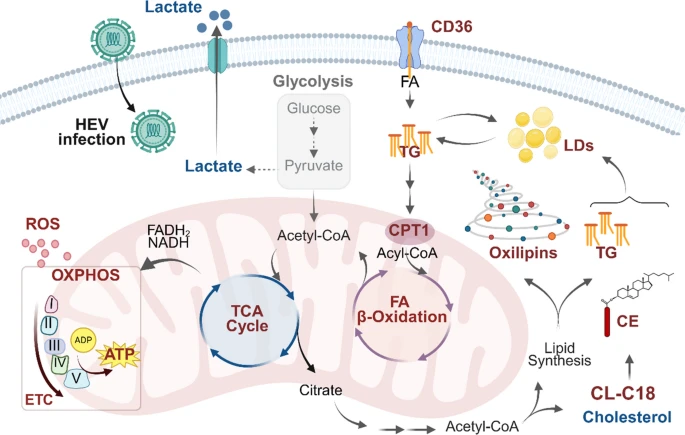
Building on this foundation, our current study employed a systems biology approach in hepatocyte cell lines to map how HEV-1 and HEV-3 remodel host metabolism (Glaziou et al. 2026, Molecular and Cellular Life Sciences). Multi-omics analyses revealed extensive reprogramming of the tricarboxylic acid (TCA) cycle, mitochondrial oxidative phosphorylation (OXPHOS), fatty acid metabolism, and β-oxidation, supporting the energetic and biosynthetic demands of viral replication. Lipidomic profiling showed increased long-chain neutral lipids, accumulation of lipid storage organelles, and elevated levels of bioactive pro-inflammatory lipid mediators. Functional assays confirmed that HEV relies on lipid-fuelled OXPHOS rather than glycolysis, and distinct metabolic programs were observed for HEV-1 versus HEV-3, consistent with their differential pathogenic potential.
Together, our studies highlight two complementary aspects of HEV pathogenesis. In the placenta, our prior work shows that HEV-1 triggers inflammatory damage at the maternal-fetal interface, providing a mechanistic explanation for severe pregnancy outcomes. In hepatocyte cell line, the current study demonstrates how HEV rewires host metabolic pathways, including mitochondrial OXPHOS and lipid metabolism, to sustain viral replication. While these findings illuminate key mechanisms of HEV pathogenesis, the metabolic landscape of the placenta during HEV infection remains largely unexplored. Investigating how HEV exploits placental metabolism could reveal genotype-specific vulnerabilities contributing to pregnancy complications and identify potential targets for therapeutic intervention.
Read the full article Cell Mol Life Sci. 2026 Jan 8. DOI: 10.1007/s00018-025-05994-1