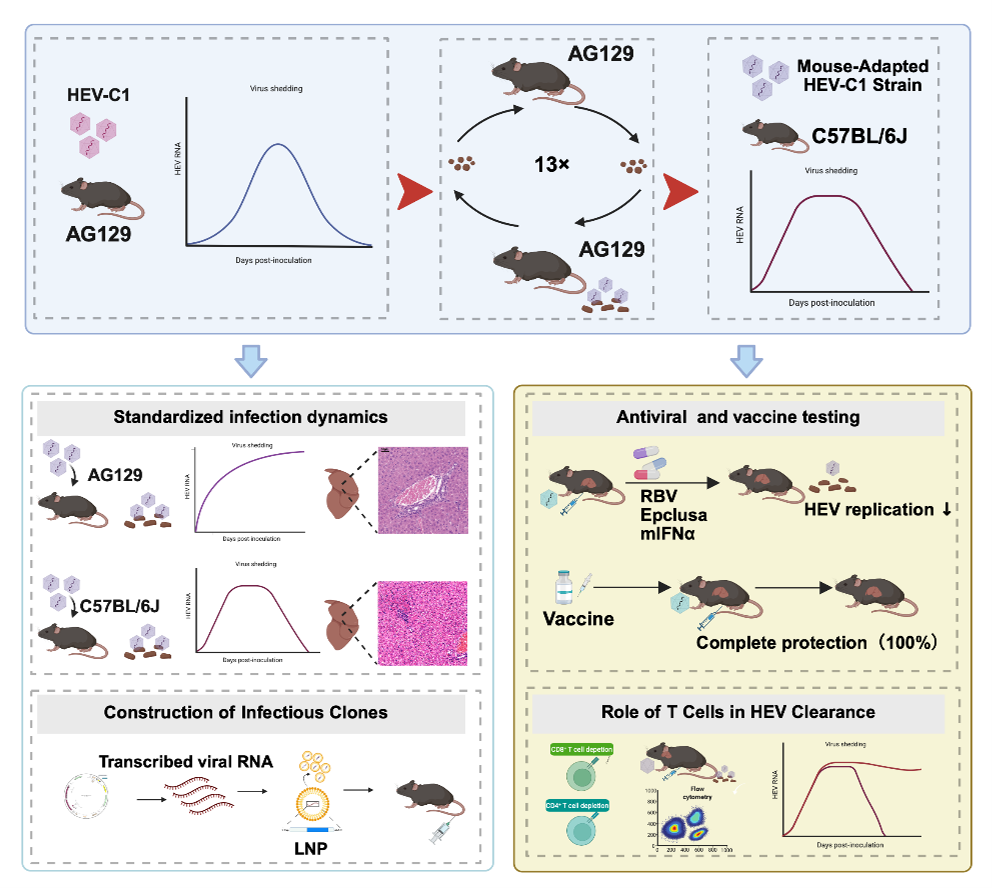
Globally, hepatitis E virus (HEV) is one of the leading causes of acute viral hepatitis and an emerging cause of chronic viral hepatitis, with roughly 19.47 million symptomatic cases in 2021 and approximately 44,000 related deaths. Pregnant women and patients with cirrhosis are particularly vulnerable to acute HEV infections, with a mortality rate of up to 30%. Immunosuppressed individuals have a heightened risk of developing chronic hepatitis E, with 10% of patients rapidly progressing to deadly cirrhosis. The replication cycle and pathogenesis of HEV remain unclear. Currently, there are no specific anti-HEV drugs. Only one hepatitis E vaccine, licensed in China and Pakistan, is currently being manufactured and has proven to be effective and safe. However, recent experimental studies have shown reduced protective efficacy of the current vaccine against the emerging zoonotic human-pathogenic rat HEV variant (HEV-C1, Rocahepevirus ratti), which poses a novel threat to humans.
Mouse models are integral to the study and treatment of viral diseases. In recent years, substantial efforts have been made to develop murine models of human hepatitis viruses, including hepatitis A virus infection using immunodeficient mouse strains, and hepatitis C virus infection using a rat-restricted hepacivirus strain. However, important gaps remain for HEV, and an immunocompetent mouse model infected with a clinically relevant virus is warranted.
Recently, Dr. Lin Wang and Dr. Tianxu Liu in Peking University, Beijing, China, has successfully established mouse models acute and chronic HEV infection. HEV research is hampered by the lack of suitable small-animal models, and their study fills this gap by establishing two mouse models, particularly the immunocompetent C57BL/6J mouse model, which should support the use of versatile genetic and immunological tools for deep mechanistic studies in the future. This study also provides a single-cell atlas of HEV infection dynamics, revealing intrahepatic viral tropism. They identified CD4+ T cell depletion as a pivotal driver of chronic infection. These mouse models offer a robust platform for studying HEV immunopathogenesis, evaluating antivirals and vaccines, and investigating mechanisms of cross-species transmission.
Using the emerging human-pathogenic rat HEV-C1 genotype, Dr. Wang’s team demonstrates that disruption of both type I and type II interferon signaling enables viral infection in mice (AG129, Ifnar1−/−Ifngr1−/− mice). Although the phenotype observed in A129 mice suggests a more prominent role for type I interferon signaling in HEV-C1 clearance, the antibody-mediated blockade experiments indicate that both type I and type II interferon pathways contribute to viral control. The precise mechanisms underlying their relative contributions and potential interplay during HEV-C1 infection remain to be elucidated. Although many details remain to be resolved, AG129 mice provide a useful model that recapitulates many aspects of chronic hepatitis E in humans. By passaging the virus in AG129 mice, we generated an adapted P13 variant that can infect wild-type C57BL/6J mice, thereby establishing an immunocompetent mouse model for HEV infection.
In conclusion, they established robust and versatile inbred mouse models that support HEV-C1 infection and provide a useful platform for investigating HEV biology and pathogenesis. These models also facilitate studies of HEV pathogenesis and may serve as valuable tools for the preclinical evaluation of antiviral agents and HEV vaccines.
The study was published in Journal of Hepatology. 2026 Sep 11:S0168-8278(26)02891-6. DOI: 10.1016/j.jhep.2026.08.034