Hepatitis E virus (HEV), is a leading cause of viral hepatitis globally, and is associated with adverse outcomes during pregnancy. Despite its clinical significance, the mechanisms driving enhanced HEV replication during pregnancy remain poorly understood. This gestation-associated enhancement of disease appears to be mainly associated with HEV-1, although other HEV genotypes have also been reported to be associated with enhanced manifestation of diseases during pregnancy.
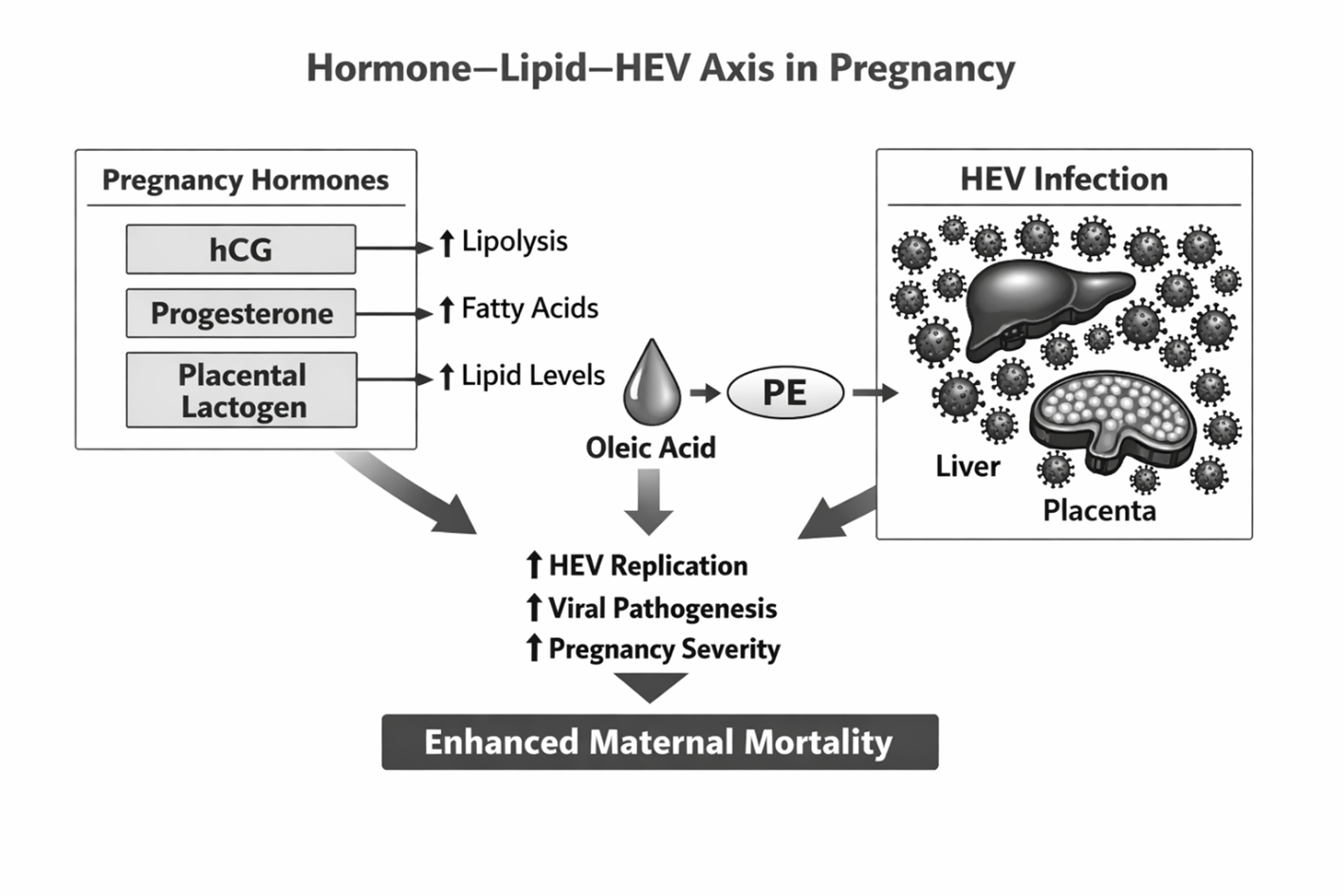
A recent study led by Dr. Kush Kumar Yadav (from The Ohio State University, and Virginia Polytechnic Institute and State University), Dr. Menuka Bhandari (from The Ohio State University, and Virginia Polytechnic Institute and State University) under the direction of Associate Prof. Dr. Scott Kenney (from The Ohio State University and senior author and University Distinguished Professor Dr. Xiang-Jin “X.J.” Meng (from Virginia Polytechnic Institute and State University) identifies a lipid-driven mechanism that enhances HEV replication, demonstrating that fatty acids such as oleic acid (OA) and the phospholipid phosphatidylethanolamine (PE) play important roles in HEV replication. Lipidomic profiling revealed that HEV infection elevates fatty acid and PE levels in human liver cell culture systems as well as in HEV3-ra-infected pregnant rabbits, with OA emerging as a key enhancer of viral replication. The study further demonstrates that the predicted HEV ORF1 fatty acid-binding domain (FABD) is capable of potentially interacting with OA, suggesting a potential direct molecular mechanism for lipid-mediated viral enhancement. They show that the FABD is relatively conserved across the four major genotypes of HEV (HEV-1, HEV-2, HEV-3 and HEV-4), thus supporting the possibility of a potential shared dependency on lipid-driven virus replication. Additionally, PE biosynthesis was demonstrated to be essential for efficient HEV replication, as CRISPR/Cas9 knockout or siRNA knockdown of PE significantly reduced viral replication.
Furthermore, they demonstrated that the pregnancy hormones potentially play a role as an amplifier for the lipid dependent vulnerability. Placental lactogen, which increases in concentration sharply in late gestation, increased intracellular fatty acid abundance and boosted HEV replication in human liver and placental cell culture systems. Additionally, pregnancy hormones that promote lipolysis, such as progesterone and human chorionic gonadotropin (hCG), also enhanced virus replication, whereas estrogen and prolactin hormones, which do not promote lipolysis, had no significant effect on viral replication. In pregnant rabbits, HEV-3ra infection led to elevated fatty acids and PE in serum, liver, and placenta, aligning with in vitro findings, thereby supporting the hypothesis of a hormone-lipid-HEV axis that potentially contributes to the pregnancy-associated adverse outcomes.
The results from this study suggest that HEV exploits gestational lipid remodeling to enhance viral replication, offering a potential mechanistic insight into pregnancy-specific pathogenesis and underscoring lipid pathways as potential targets for intervention strategies.
Dr. Kush Kumar Yadav is an Assistant professor at the Department of Animal Sciences, College of Food, Agricultural and Environmental Sciences, The Ohio State University.
Dr. Menuka Bhandari is a Bioinformatician at the Research and Analytical Service Core, College of Food, Agricultural and Environmental Sciences, The Ohio State University.
Dr. Scott P. Kenney is an Associate Professor at Center for Food Animal Health, Department of Animal Sciences, College of Food, Agricultural and Environmental Sciences, The Ohio State University.
Dr. X.J. Meng is a University Distinguished Professor at the Virginia-Maryland College of Veterinary Medicine, Virginia Polytechnic Institute and State University (“Virginia Tech”), Blacksburg, Virginia.
Read the full article published in Proc. Natl. Acad. Sci. USA. 2026 Jul 7; 123 (27): e2614150123; DOI: 10.1073/pnas.2614150123