Viral infections in host cells generally follow two major patterns: lytic and nonlytic, which are fundamental to viral life cycles and pathogenesis. In a lytic infection, the virus rapidly replicates within the host cell, resulting in cell lysis and release of progeny virions. In contrast, nonlytic infections initially preserve host cell integrity but exhibit more complex pathophysiology, driven largely by immune-mediated processes. Diseases associated with nonlytic infections often arise indirectly through dysregulated immune responses, leading to pathological inflammation and tissue damage.
Hepatitis E virus (HEV) is a typical nonlytic virus that does not directly cause injury to infected liver epithelial cells. However, acute HEV infection, particularly in pregnant women, can lead to severe complications. Severe liver inflammation in acute HEV infection is closely linked to immune dysregulation, with macrophages playing a central role.
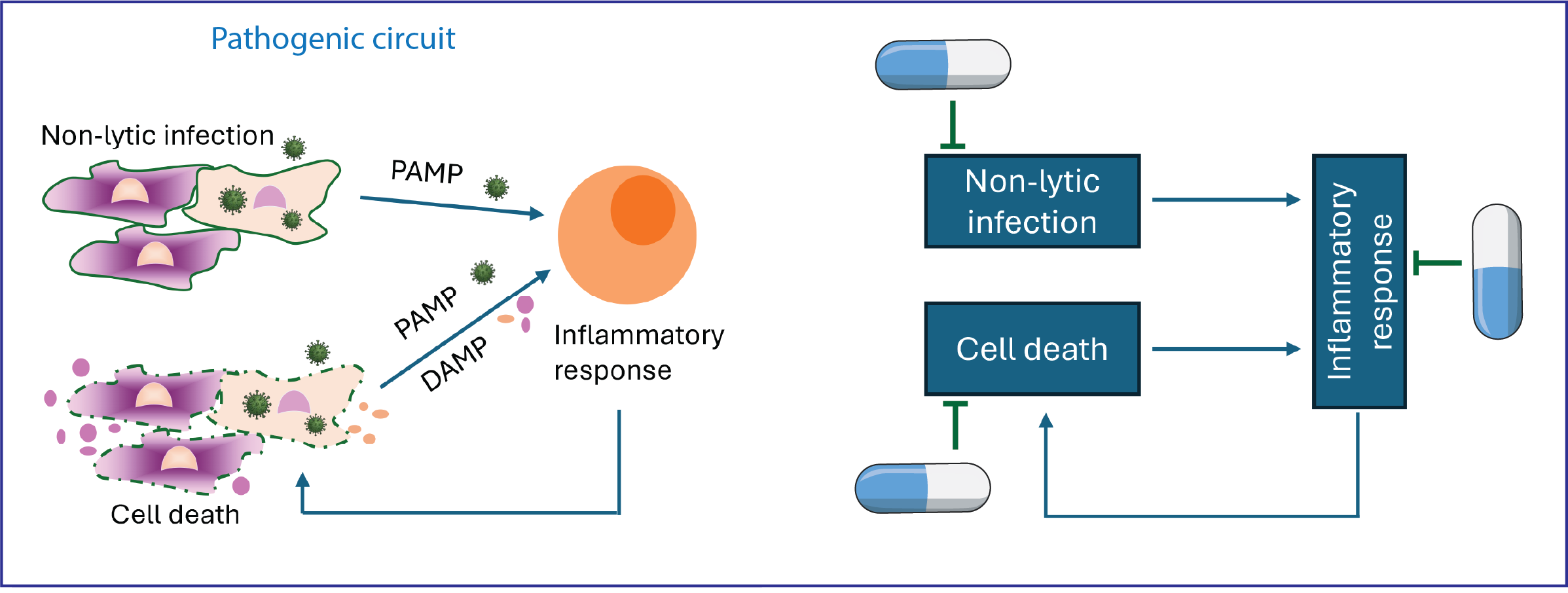
A recent study from the group of Qiuwei Abdullah Pan at Erasmus Medical Center in the Netherlands illustrates the complexity of pathophysiology caused by nonlytic HEV infection driven by immune cells, using macrophage-augmented organoids (MaugOs). To conceptualize this complexity, this study proposes a pathogenic “circuit” comprising three interconnected nodes: nonlytic infection, inflammation, and immune-mediated cell death. The team demonstrated successful recapitulation of the pathogenic circuit induced by HEV infection in MaugOs. Nonlytic HEV infection triggered robust inflammatory responses and subsequent cell death involving pyroptosis, apoptosis, and necroptosis pathways. By pharmacologically targeting individual circuit nodes as well as individual cell death pathways, the team have dissected their interactions and identified potential therapeutic targets. They further developed multitarget strategies by simultaneously targeting two or three nodes through rational drug combinations to effectively disrupt the pathogenic loop.
These findings bear implications for understanding many other nonlytic viral infections (see featured image above). Briefly, the virus does not kill infected cells, but PAMPs (Pathogen-Associated Molecular Patterns; e.g. viral DNA /RNA) released can activate inflammatory response, which then causes cell death, release of DAMPs (Damage-Associated Molecular Patterns), and tissue damage. Therapeutic interventions can be designed to target any single node of the circuit or to simultaneously modulate two or all three nodes to achieve improved outcomes.
Read the full article: Proc Natl Acad Sci U S A. 2026 May 19;123(20):e2603870123. DOI: 10.1073/pnas.2603870123