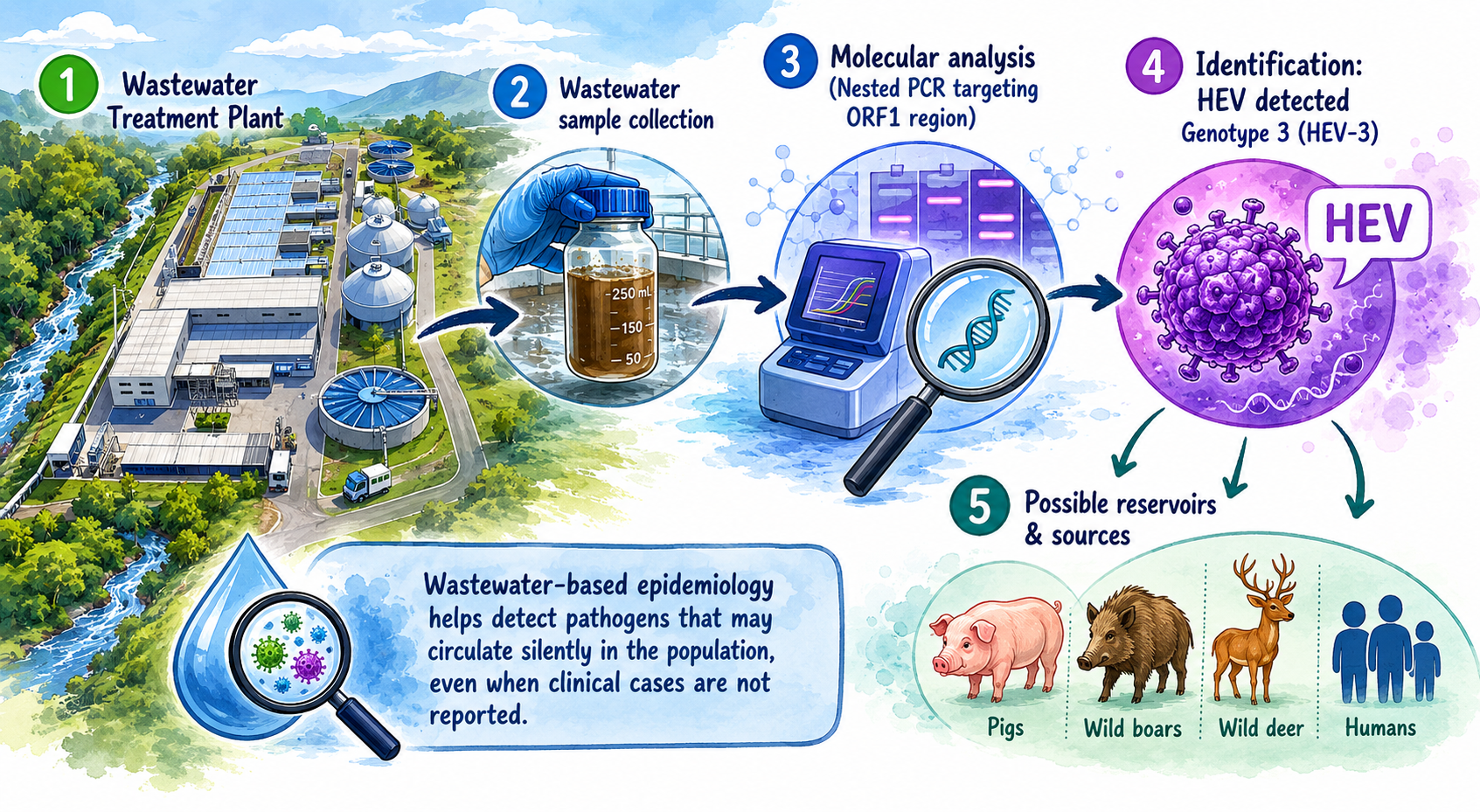
Recently, the first detection of hepatitis E virus (HEV) in wastewater in Costa Rica was reported, representing also the first environmental report of this virus in Central America.
The study analyzed 54 influent and effluent wastewater samples collected during 2025 from the main wastewater treatment plant serving the Greater Metropolitan Area of the country. Although HEV was not detected using RT-qPCR, a nested PCR approach targeting the ORF1 region identified positive influent samples, highlighting the value of combining sensitive molecular approaches for the detection of pathogens that may circulate silently within the population.
Phylogenetic analysis of the obtained sequences showed that the detected strains clustered within genotype 3 (HEV-3), a genotype commonly associated with zoonotic transmission and previously linked to infections in both humans and animal reservoirs, particularly swine.
The findings reinforce the value of wastewater-based epidemiology as a public health surveillance strategy capable of identifying pathogens that may circulate unnoticed in the population, particularly in regions where routine clinical testing remains limited. The study also emphasizes the importance of strengthening environmental surveillance capacities in tropical low- and middle-income countries.
The work was carried out by researchers from the Instituto de Investigaciones en Salud (INISA) at the Universidad de Costa Rica and the Instituto de Virología “Dr. J. M. Vanella” at the Universidad Nacional de Córdoba, Argentina. The study was supported by the Universidad de Costa Rica and benefited from the collaboration of the Instituto Costarricense de Acueductos y Alcantarillados (AyA), which facilitated access to wastewater treatment infrastructure and sample collection activities.
Read the full article published in Food and Environmental Virology, 2026 May 20;18(2):23. https://doi.org/10.1007/s12560-026-09696-0
Note: the cover image was generated with DALL·E via ChatGPT (OpenAI).